

Go hiomlán Uathoibríoch Ríomhchlárú Robot Spraeáil


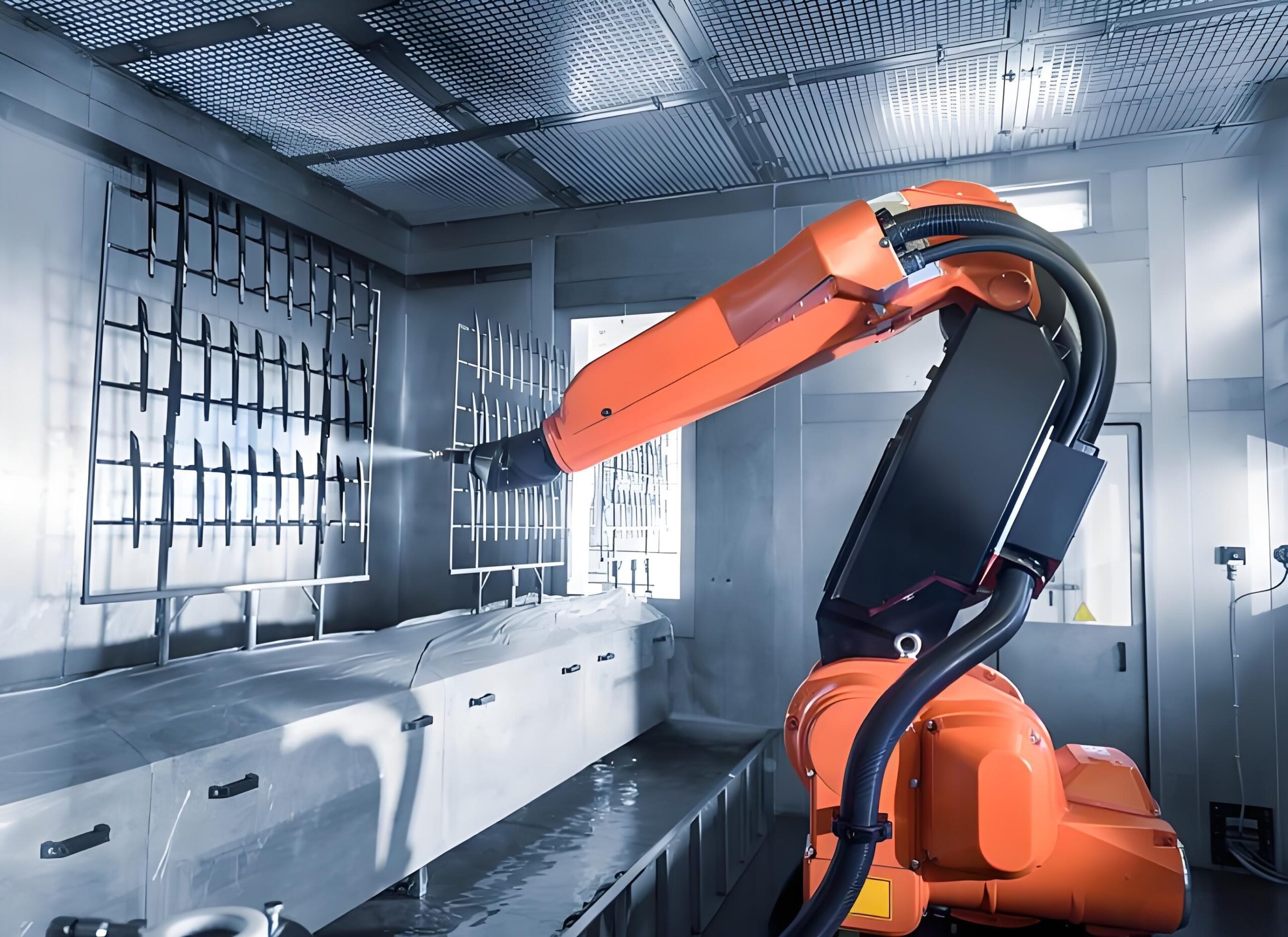
The fully automated programming robot spraying system is an important component of modern industrial coating production lines, particularly suitable for high-precision, high-efficiency spraying operations. The robot spraying system utilizes the precise movements of robotic arms combined with automated control technology to complete the coating process. Through pre-programmed operations, the robot can precisely spray according to the complex shapes of workpieces, ensuring an even and consistent coating, reducing manual labor, and improving production efficiency.
1. Components of the Robot Spraying System
A fully automated programming robot spraying system generally consists of the following parts:
– Robot body: The robotic arm is the core of the spraying system and is capable of precise trajectory control.
– Spray gun: Used for spraying coatings, usually mounted at the end of the robotic arm, controlling the spraying angle, flow, and speed through the gun.
– Spraying control system: Controls the operation of the robot and spray gun, including spraying parameters, spraying paths, coating thickness, and more.
– PLC controller and programming system: The PLC (Programmable Logic Controller) combined with the robot programming system is used to set the robot’s working paths, movements, spraying speed, and spraying modes.
2. Programming and Path Planning
Before starting spraying operations, the robot needs to be programmed to set the spraying path, spraying speed, material flow, and other parameters. Programming and path planning are key steps to ensure uniformity and precision of coatings.
Programming:
– 3D modeling: First, use CAD or 3D modeling software to create a virtual model of the workpiece, including its dimensions, shape, and the required spraying areas.
– Path planning: Programming of the robot paths generally uses an “offline programming” method, where the robot’s motion trajectory is planned using a computer system to avoid real-time adjustments during production. The robot follows the planned path accurately, spraying at every designated position.
– Spraying parameter settings: Parameters such as spraying angle, speed, distance from the spray gun to the workpiece, and material flow are also set during programming. Depending on the complexity of the workpiece, the robot can spray multiple angles and directions to ensure coating uniformity.
Offline Programming:
Offline programming is typically done on a computer. After connecting the robot control system to the offline programming software, the operator can set the spraying trajectory, actions, spraying modes, etc., according to the specific requirements of the workpiece, and simulate the path in a virtual environment. This reduces debugging time during production and directly improves production efficiency.
3. Spraying Operations: Principles of Robot Spraying
Once programming is completed and uploaded to the robot control system, the robot begins the spraying task according to the set path and parameters. The main principles and steps of the spraying process are as follows:
Robot Spraying Actions:
Spray Gun Movement: The robot moves the spray gun over the workpiece surface through its precise robotic arm movements, spraying back and forth along a predetermined path. Robots typically use six-axis or higher robotic arms, enabling the spray gun to reach complex workpiece shapes and ensuring all-around coating.
Precise Spraying: Robot spraying systems usually employ high-pressure airflow or electrostatic spraying technology, spraying the coating onto the workpiece surface through high-pressure airflow. Electrostatic spraying charges the powder coating, ensuring uniformity and adhesion of the coating.
Spraying Angle and Distance: The robot accurately controls the spray gun’s angle and the distance between the spray gun and the workpiece according to the predetermined path and angles, ensuring consistent coating thickness and avoiding runs or uneven coating.
Layer Adjustment: For thicker coatings, the robot can perform multiple spraying operations, adjusting the thickness and uniformity of each layer after each pass. Multi-layer coating ensures better protection and appearance quality.
Spraying Control System:
Real-time Feedback and Adjustment: Some variables during the spraying process, such as spraying pressure and paint flow, may be affected by environmental changes. To ensure coating quality, the spraying control system monitors in real time and adjusts parameters based on feedback.
Precise Control of Paint Flow: The system precisely adjusts the paint flow through electric or pneumatic valves, ensuring that each spray meets the predetermined coating requirements.
Spraying Quality Monitoring and Automatic Adjustment:
Fully automatic programmed robot spraying systems can monitor in real time to ensure consistency in spraying quality.
Coating Thickness Detection: The robot system can be equipped with online coating thickness measuring instruments to measure the thickness of the coating on the workpiece in real time, ensuring uniform layers and compliance with standards.
Defect Detection and Correction:
Visual Inspection System: Using machine vision technology and high-resolution cameras, the coating is monitored for defects such as bubbles, runs, or misses. If problems are detected, the robot can automatically correct the spray path or adjust spray parameters.
Post-processing: After the coating cures, the workpiece usually undergoes surface inspection, cleaning, or packaging as post-processing steps.
The fully automatic programmed robot spraying system achieves high-quality coating results through efficient programming, precise spray control, and real-time quality monitoring. It can accurately control the spray path, coating thickness, and paint flow according to the shape, size, and requirements of different workpieces, ensuring even, smooth, and durable coatings. Automation with robots not only improves production efficiency but also significantly reduces human error, making it widely applicable in industries such as automotive, fearais tí, and electronics, meeting the needs of modern high-precision spraying.