

Fully automatic powder coating production line
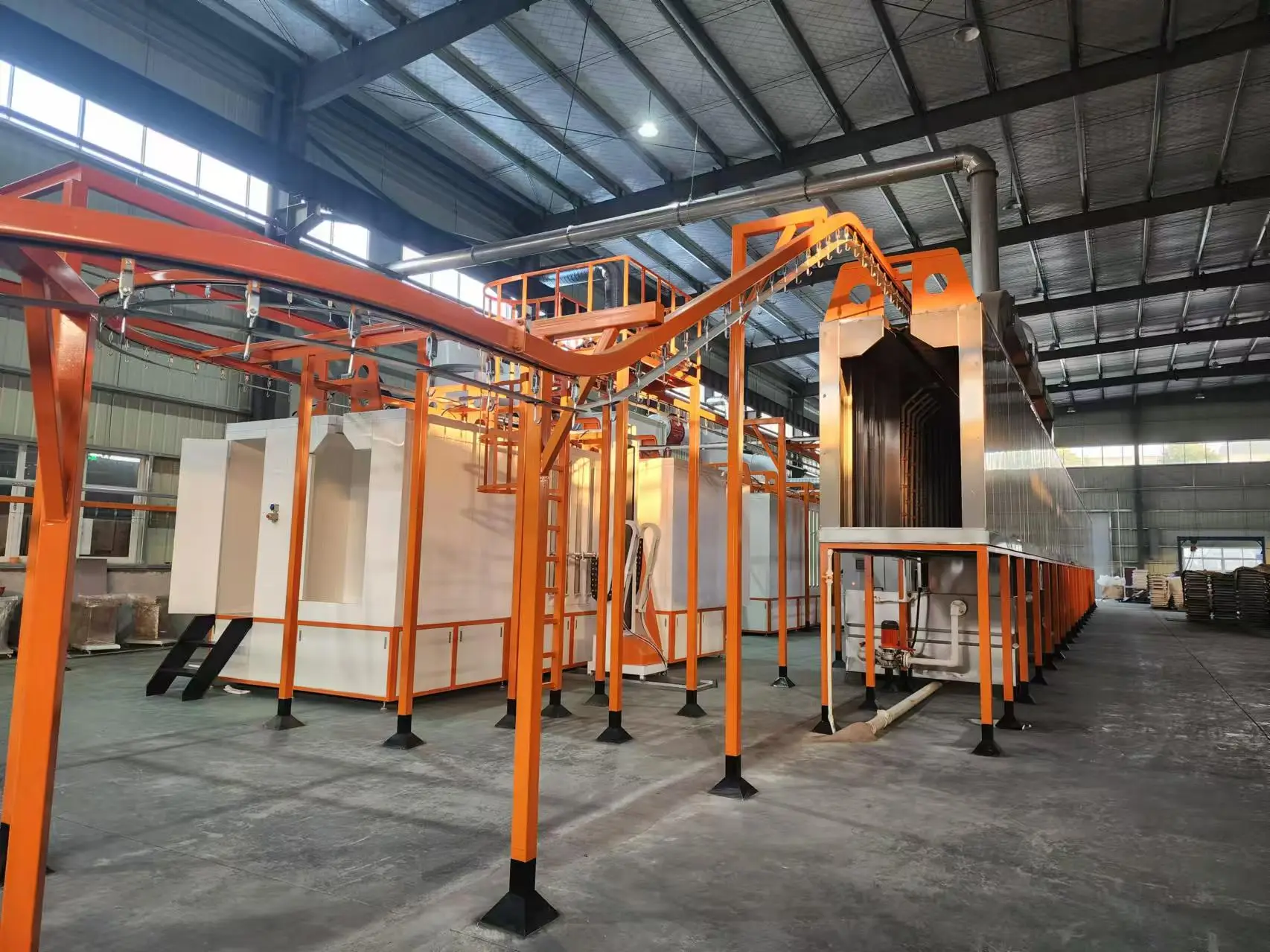


Detailed Production Process of Fully Automatic Powder Coating Production Line
The fully automatic powder coating production line ensures efficient and high-quality coating through a series of precise processes. The main production processes of this production line are as follows:
1. Pretreatment Stage
Pretreatment is the first step in the powder coating production line. Its purpose is to remove oil, oxides, rust, and other impurities from the surface to be coated, providing good adhesion for the coating. The pretreatment process typically includes the following steps:
– Degreasing: Use a special degreasing agent to clean the metal surface and remove oil.
– Rust and pickling: Use pickling solution to remove surface rust or oxide layers, ensuring a smooth metal surface.
– Phosphating: Form a phosphate film on the surface to enhance the adhesion of the coating to the metal.
– Drying: Use high-temperature drying equipment to remove moisture from the metal surface, ensuring uniformity during the coating process.
The purpose of this stage is to provide a solid foundation for subsequent coating, ensuring the quality and adhesion of the coating.
2. Powder Spraying Stage
During the powder spraying stage, powder coating is evenly sprayed onto the pretreatment-treated workpiece surface using automatic spraying equipment. Key technologies in this process include:
– Automatic spray gun: The spray gun automatically adjusts the spraying angle, thickness, and powder quantity according to preset parameters, ensuring an even coating.
– Electrostatic spraying technology: The powder coating is charged through corona discharge, allowing it to adhere to the workpiece surface and ensuring a uniform coating without dead spots.
– Fine spraying control: Advanced control systems ensure precise adjustment of powder quantity and spraying speed to achieve the optimal coating effect.
The powder spraying stage is the core of the coating process, where the powder coating uniformly adheres to the workpiece surface, forming an initial layer.
3. Curing Stage
In the curing stage, the coated powder layer needs to be cured through high-temperature baking, transforming it into a hard and durable coating. The curing process includes the following steps:
– Preheating oven: The workpiece enters the preheating oven, where heating softens and levels the powder coating in advance, ensuring the uniformity of the coating.
Main Oven Curing: The workpiece enters the high-temperature curing zone, where the powder coating cures at a temperature of 160°C–200°C, undergoing a chemical reaction to form a durable coating.
Cooling: The cured workpiece passes through a cooling channel, gradually lowering the temperature to ensure the hardness and durability of the coating.
The cured coating has excellent corrosion resistance, scratch resistance, and high impact resistance, ensuring the product’s service life.
4. Powder Recovery System
To improve production efficiency and reduce material waste, the powder coating production line is equipped with an advanced powder recovery system. The functions of this system include:
Powder Recovery: Powder that does not adhere to the workpiece surface during spraying is collected, filtered, and recirculated to maximize powder utilization.
Automatic Cleaning: Periodically and automatically cleans the interior of the spraying system to ensure smooth spraying and high-quality coating.
The powder recovery system not only reduces raw material costs but also meets environmental protection requirements and reduces waste generation.
5. Inspection and Packaging
Finally, the coated workpieces undergo strict quality inspection to ensure that the surface coating is flawless, the thickness meets standards, and the coating is strong and durable. The inspection process includes:
Appearance Inspection: Check that the coating is uniform, free of bubbles, scratches, or defects.
Coating Thickness Test: Measure the coating thickness with a coating thickness gauge to ensure it meets technical standards.
Adhesion Test: Check the coating’s adhesion to the substrate through pull tests and scratch tests to ensure it meets requirements.